Post-Signature Contract Management: From Signed PDF to Governed Record
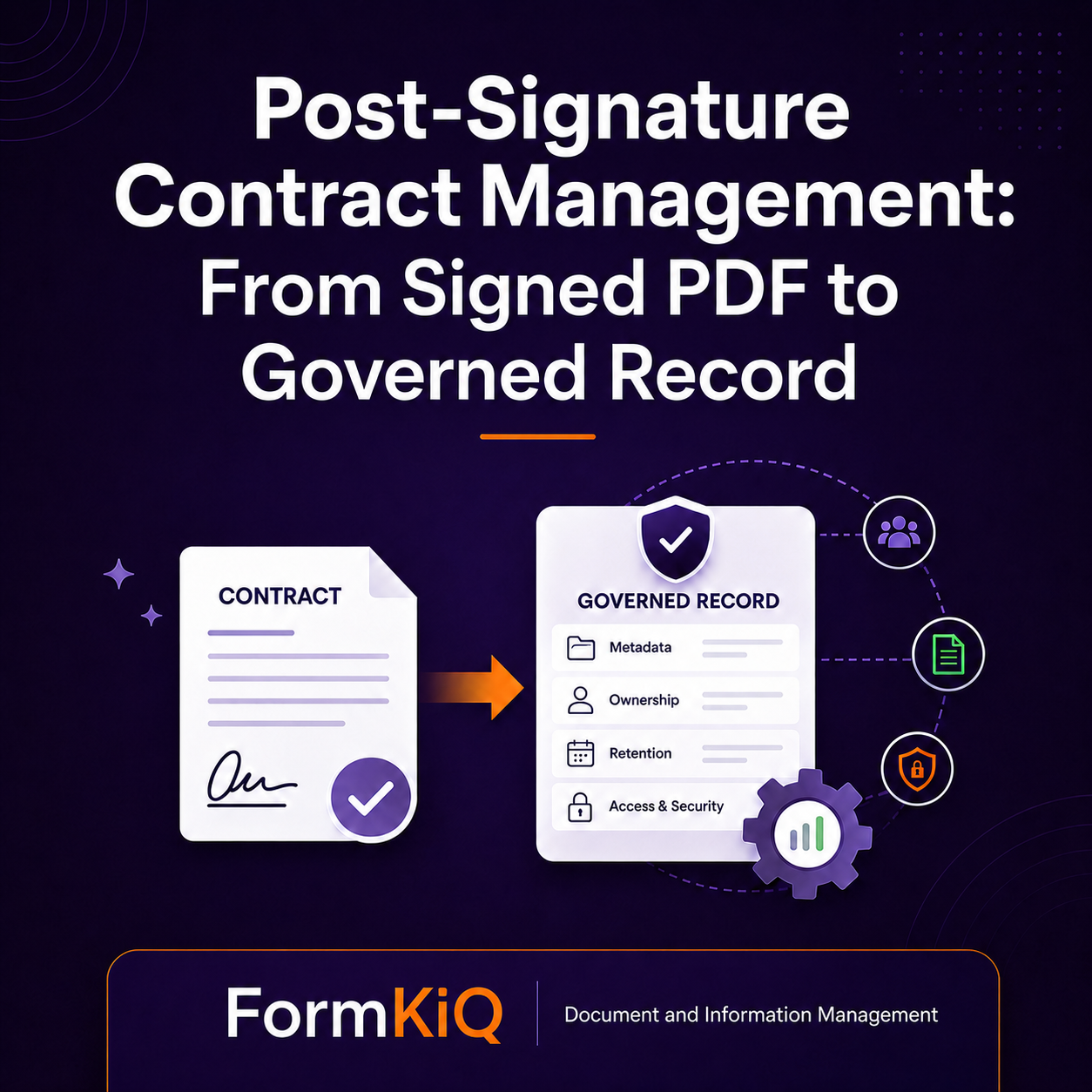
Most organizations treat contract signing as the finish line. It's actually the starting line for governance.

Most organizations treat contract signing as the finish line. In reality, it's the starting line for governance — and what happens next determines whether that contract becomes a business asset or a hidden liability.
The Gap After the Agreement Is Signed
Picture this: your legal team just closed a major vendor agreement. The signed PDF lands in someone's inbox, gets
uploaded to a shared drive, maybe renamed something like VendorX_Agreement_Final_v3_SIGNED.pdf.
Everyone moves on.
Six months later, a compliance audit asks for all active contracts with data processing clauses. Or procurement needs to know which vendor agreements are up for renewal in Q3. Or legal gets a discovery request and needs to place a hold on everything related to a specific supplier.
That signed PDF — the one sitting in a folder somewhere — might as well not exist. It's unsearchable, ungoverned, disconnected from the systems that need it, and invisible to the people responsible for managing the obligations it contains.
Organizations that invested in a contract lifecycle management (CLM) tool often assume this problem is solved, but most CLMs are built for the pre-signature workflow: drafting, redlining, approvals, and eSignature. Once the contract is executed, many CLMs offer little more than a repository. They may lack the depth of full-text and metadata-driven search, retention and disposition enforcement, auditability, or data residency control needed for governed contract records. The contract is signed and stored, but it still isn't governed.
Whether your signed contracts live in a shared drive or a CLM that wasn't designed for post-signature governance, the gap is the same: the signing workflow gets all the attention (and all the software budget), while the far more consequential post-signature lifecycle lacks the controls it needs.
Why Contracts Need More Than Storage
Contracts are unique among business documents. A signed contract isn't simply a file to be stored: it's a binding record that creates obligations, triggers deadlines, defines relationships, and carries regulatory implications that can span years or even decades.
This makes contracts fundamentally different from most of the documents flowing through an organization. An invoice gets processed and archived. A project plan evolves and eventually becomes historical. But a contract remains active: its terms govern ongoing business operations, its renewal dates drive future decisions, and its compliance requirements demand continuous attention.
The challenge is that traditional document management treats contracts the same way it treats everything else: as files to be stored and retrieved. What contracts often need, especially after signature, is governance — a system that understands what's inside them, enforces policies around them, tracks obligations over time, and maintains the kind of audit trail that regulators and legal teams require.
What Makes a Contract Record Governed?
A governed contract record is more than a signed PDF with a filename. It combines the authoritative signed document with extracted business metadata, classification, retention rules, access controls, audit history, related correspondence, key dates, obligations, and system links — all managed as one coherent record.
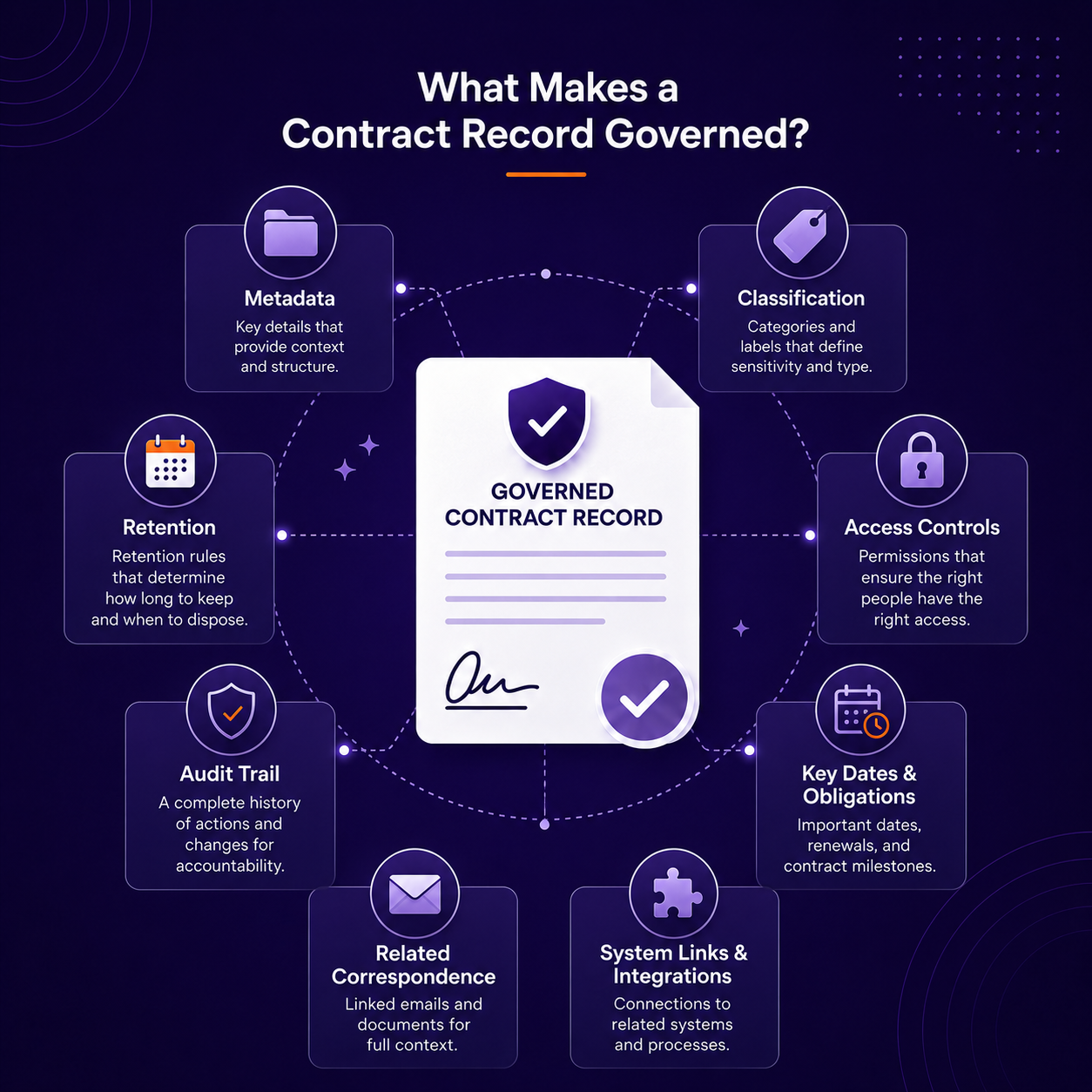
That record can then be searched by clause or jurisdiction, reported on for renewal planning, protected under legal hold, integrated with financial and procurement systems, and eventually disposed of according to policy.
In practical terms, a governed contract record enables day-to-day capabilities that matter to the people who manage contracts across the organization:
- Renewal and expiry dashboards that surface upcoming deadlines before they become missed opportunities or auto-renewals.
- Obligation and milestone tracking that connects contract commitments to the teams responsible for delivering on them.
- Responsible-owner assignment so that every contract has clear accountability, not just a folder it belongs to.
- Alerts and review workflows that route contracts for periodic review, renegotiation, or escalation based on defined triggers.
- Legal hold and retention controls that protect contracts during litigation and enforce disposition schedules when they expire.
- Clause, party, date, and jurisdiction search across the entire contract portfolio — not just filenames and folder paths.
- Integrations with ERP, CRM, eSignature, and email systems that keep contract data connected to the business processes it governs.
Without these capabilities, a signed contract is just a file. With them, it becomes an active business record that drives decisions, reduces risk, and supports compliance.
How FormKiQ's Platform Layers Support Governed Contracts
For many organizations, solving the post-signature contract problem is not only about the signing workflow or a standalone contract repository. It requires a governed document platform that can preserve the record, extract the right data, enforce policy, and connect contract information to the systems that depend on it. That platform may replace an ad hoc shared-drive process, or it may provide the governance layer that a CLM was never built to deliver.
FormKiQ approaches this through interconnected solution layers, each building on the one below it.
The Document Platform Foundation
At the base, you need core document management capabilities that can handle the full lifecycle of a contract: secure storage, version control, metadata tagging, full-text search, and the ability to process documents intelligently on intake. FormKiQ's Document Platform provides this foundation through cloud-native, serverless infrastructure running in your own AWS account — meaning your contracts never leave your security perimeter.
When a signed contract PDF enters the system, the platform can immediately trigger intelligent document processing. Using OCR and AI-powered extraction, FormKiQ can pull out key data points like effective dates, party names, contract values, renewal terms, and governing law, then attach them as structured metadata. What was a flat, static PDF becomes a richly tagged, searchable record as part of the intake process.
Metadata tagging → Full-text indexing → Searchable contract record
The Document Governance Layer
Storage and search are table stakes. What transforms a stored document into a governed record is the governance layer that sits above the platform.
FormKiQ's Document Governance capabilities bring retention and disposition policies, document legal holds, and audit-ready controls to every contract in the system. This means you can define retention schedules that automatically enforce how long different contract types must be kept, and when they should be disposed of. When litigation arises, legal holds can be applied that override normal retention rules and preserve everything relevant to a matter.
Data residency and data sovereignty controls ensure that contracts stay where they need to stay, whether that's driven by regulatory requirements or internal policies about where sensitive agreements can be stored. And because FormKiQ deploys into your own AWS environment, you maintain complete control over where your data lives. There is no third-party SaaS provider holding your most sensitive business records.
The audit trail becomes especially important for contracts. Every access, every modification, every policy action is logged and traceable. When an auditor asks "who accessed this agreement and when?" or "was the retention policy properly applied?", the answer should be readily available.
Regulatory Framework Alignment
Contracts often sit at the intersection of multiple compliance obligations. Different contract types may need to be managed in ways that support different regulatory frameworks: healthcare agreements may involve HIPAA-related controls, contracts involving European personal data may require GDPR-aware handling, government contracts may be subject to specific security requirements such as FedRAMP, and financial or technology agreements may need evidence aligned with SOC 2 or ISO 27001 controls.
Rather than treating compliance as an afterthought, FormKiQ's platform enables organizations to build compliance-supporting controls into the way contracts are managed from the moment they enter the system. Classification schemas, retention policies, access controls, and audit capabilities can be configured to align with the specific frameworks an organization is measured against.
System Integrations: Contracts in Context
A governed contract record becomes exponentially more valuable when it's connected to the business systems that depend on it. FormKiQ's integration capabilities connect your contract repository to the systems where contract data is actually used:
- ERP integration links payment schedules, pricing agreements, vendor terms, and procurement data to financial systems.
- CRM integration connects customer and partner agreements to account records, renewal timelines, and relationship history.
- HRIS integration links employment agreements, NDAs, policy acknowledgements, and benefit-related contracts to employee records.
- Email integration captures contract-related correspondence and links it to the agreements being discussed.
The Business Solution: Contract Management
All of these layers converge into what FormKiQ positions as a Business Solution — in this case, Contract Management under the Legal & Governance domain. This isn't a bolted-on module; it's the natural outcome of having the right platform capabilities working together.
At the Business Solution level, contract management becomes a governed, integrated process rather than a file storage problem. Organizations can manage the complete post-signature contract lifecycle with confidence: from initial capture through obligation tracking, renewal management, compliance monitoring, and eventual disposition — all within a single platform that runs in their own cloud environment.
What This Looks Like in Practice
Consider a mid-sized company managing 500 active vendor contracts, each with different renewal dates, compliance requirements, and stakeholder responsibilities. Before implementing governed contract management, their reality looks familiar:
Contracts scattered across email attachments, shared drives, various team folders, and perhaps a CLM that supports signing but does not fully address post-signature governance. No reliable way to know what's expiring next quarter. Manual processes to track compliance obligations. No defensible audit trail for regulatory inquiries.
After transforming their contract management with FormKiQ's layered approach:
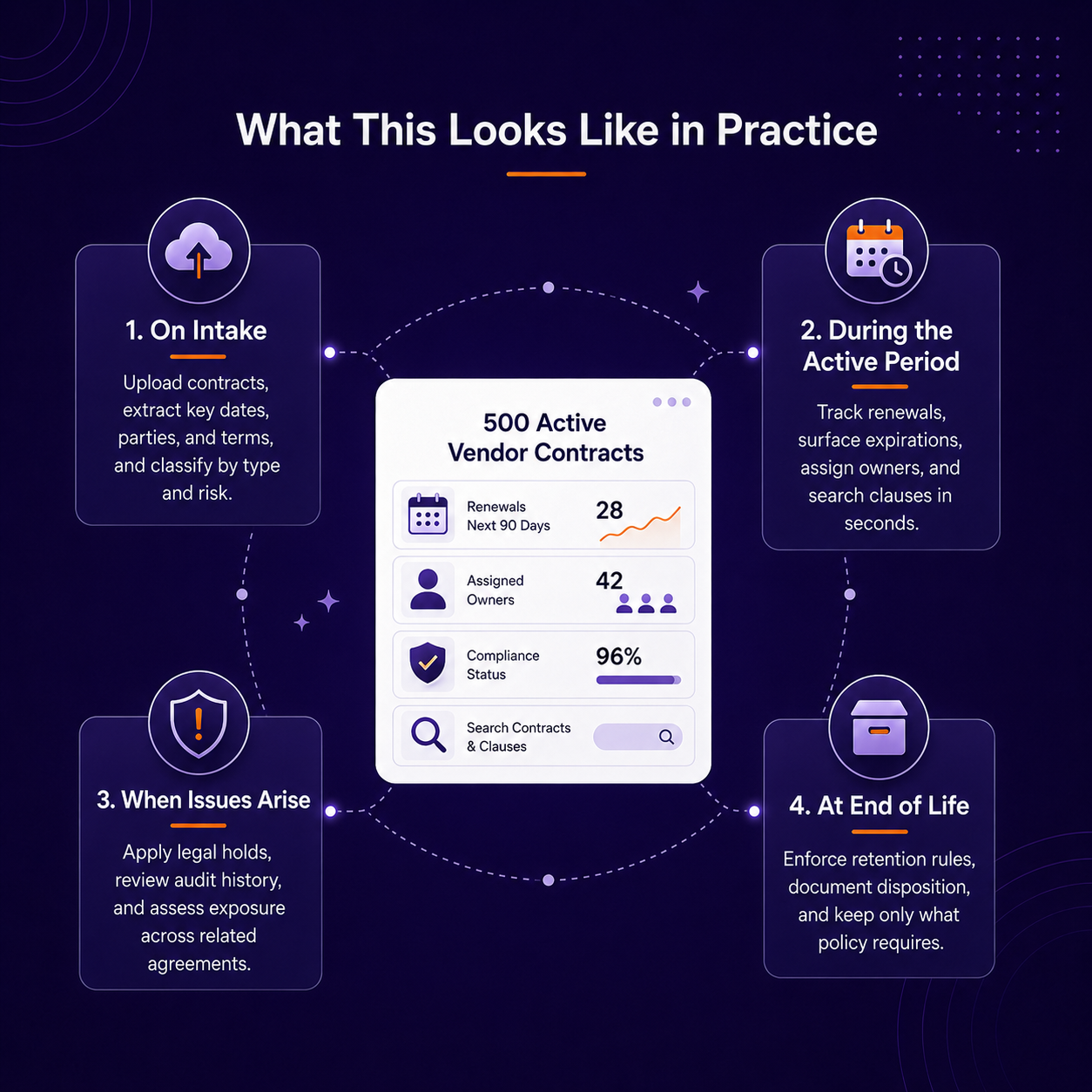
On intake, every new or renewed contract is uploaded through a consistent process. AI-powered extraction pulls key terms, dates, and parties into structured metadata. Classification schemas automatically categorize the contract by type, risk level, and compliance requirements.
During the active period, retention policies ensure contracts are maintained according to regulatory and business requirements. Workflow automation routes renewal notices to the right stakeholders at the right time. Dashboards surface upcoming expirations, and obligation tracking keeps responsible owners accountable. Full-text search means anyone with appropriate access can find any clause, in any contract, in seconds.
When issues arise, legal holds can be placed instantly across all contracts related to a matter. The complete audit trail shows exactly who accessed what and when. Integration with the ERP system means financial exposure can be assessed immediately.
At end of life, disposition policies ensure contracts are retained for exactly as long as required — not a day less for compliance, not a year more for risk — and that disposal is documented and defensible.
The Architecture Advantage
There's a reason this approach works differently from standalone contract management software or generic document storage. It comes down to two architectural decisions that FormKiQ makes differently:
First, everything runs in your AWS account. Your contracts — arguably among the most sensitive documents in your organization — never leave your security perimeter. Instead of placing your contract repository in a vendor-controlled multi-tenant SaaS environment, FormKiQ runs in your AWS account, giving your organization direct control over encryption, access, network configuration, and data residency. For organizations handling government contracts, healthcare agreements, or financial instruments, this level of control can be essential to meeting their compliance obligations.
Second, the serverless architecture means your contract management scales with your actual usage. Whether you're managing 50 contracts or 50,000, the infrastructure scales automatically without capacity planning or performance degradation. You pay for what you use, not for idle server capacity waiting for the next batch of renewals.
Getting Started
The transformation from "signed PDF" to "governed contract record" doesn't require ripping and replacing everything at once. Most organizations start by addressing their most pressing pain point — often renewal tracking or compliance audit readiness — and expand governance capabilities as the value becomes clear.
The key insight is that post-signature contract management isn't fundamentally a software problem. It's a governance problem that requires the right platform architecture to solve properly. When your document platform, governance controls, regulatory alignment, and system integrations work together as interconnected layers, contract management stops being an administrative burden and becomes a genuine source of business intelligence and risk reduction.
For organizations modernizing contract management, the first step is often not replacing every workflow. It's establishing a governed record layer for the contracts already driving the business — whether those contracts currently live in shared drives, inboxes, or a CLM that wasn't built for post-signature governance. FormKiQ can help you turn them into governed records with structured metadata, policy controls, auditability, and integrations that fit your existing cloud environment.
Contact us or schedule a consultation to learn how FormKiQ can help your organization close the post-signature gap.