EU Data Act: Planning Your Exit from a Document Platform
Move your files with the history, permissions, and business relationships that make them useful.
Published
Regulatory information checked: . The evidence model below is implementation guidance; legal duties depend on the service, role and use case.
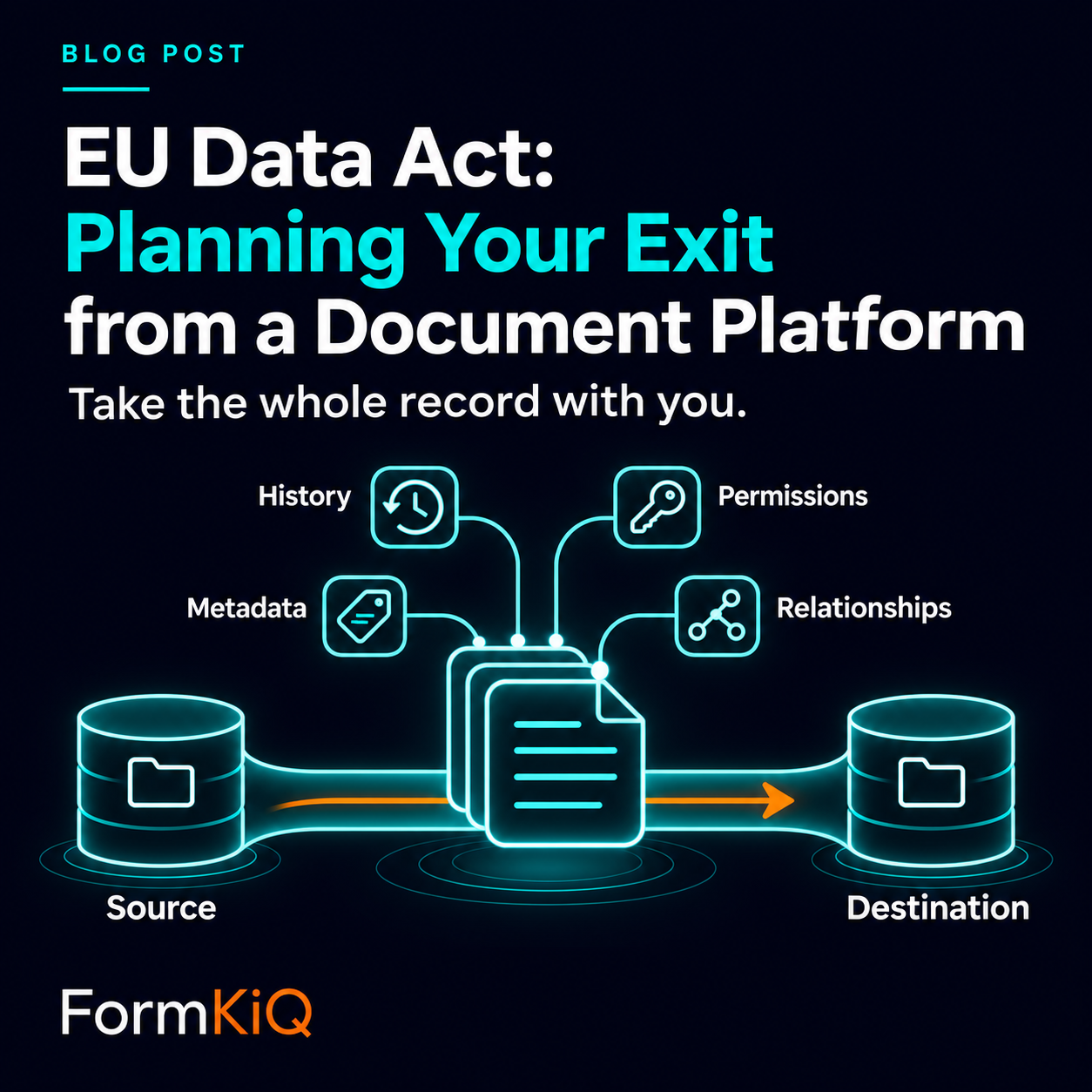
Document platform portability is often reduced to a single question: can we download our files? That question is necessary and insufficient. A usable document system also contains metadata, stable identifiers, versions, permissions, relationships, retention state, workflow history, and integration contracts.
The EU Data Act has applied since September 12, 2025. Chapter VI addresses switching between data-processing services. Its scope is the service offered, not every software licence; assess a customer-operated installation separately from a managed service. SaaS/PaaS interface and export duties differ from IaaS functional-equivalence duties. The European Commission's Data Act guidance also notes that switching charges, including switching-related data egress, are removed from January 12, 2027. This does not make every migration, destination service or optional implementation task free.
For buyers, this is a reason to make exit design part of architecture and procurement now. The cheapest time to define a reliable export is before the first migration, not during a contract dispute or accelerated replacement project.
Files are the visible part of the system
Suppose an organization exports five million files with their original names. It may still be unable to reconstruct:
- which version was approved or published;
- which contract, claim, employee, or case each document belonged to;
- which users were allowed to see it;
- whether a legal hold or retention rule applied;
- who uploaded, changed, reviewed, or deleted it;
- which downstream systems referenced its identifier;
- whether OCR text or extracted attributes were authoritative, derived, or manually corrected.
The files are present, but the information system is gone.
Define a portable document package
A practical export specification should identify the authoritative and derived elements separately. The table is our recommended migration package, not a claim that the Act requires every item in every service. Identify exportable customer data and metadata, provider IP/trade-secret exclusions, and which destination behaviours need rebuilding. Check the actual service contract and applicable exceptions.
- Layer
Binary objects
Portable contentOriginal files, renditions, signatures, and generated documents.
ValidationCounts, sizes, checksums, and missing-object report.
- Layer
Identity
Portable contentStable document IDs, source IDs, paths, and external references.
ValidationUniqueness and referential-integrity checks.
- Layer
Metadata
Portable contentAttributes, schemas, classifications, dates, and provenance.
ValidationSchema validation and value reconciliation.
- Layer
Lifecycle
Portable contentVersions, status, retention, holds, deletion state, and disposition events.
ValidationBusiness-rule and chronology checks.
- Layer
Relationships
Portable contentLinks to entities, dossiers, cases, contracts, and related documents.
ValidationOrphan and broken-link report.
- Layer
Authorization
Portable contentRoles, groups, policy inputs, and access classifications.
ValidationSampled access-equivalence testing.
- Layer
History
Portable contentAudit events, reviews, approvals, and workflow outcomes.
ValidationSequence, actor, timestamp, and completeness checks.
- Layer
Derived data
Portable contentOCR text, embeddings, thumbnails, and search fields.
ValidationDecision to migrate or reproducibly rebuild.
Open APIs help, but they do not define an exit
An API can make every object retrievable and still leave the customer with an impractical migration. Rate limits, pagination behavior, export ordering, dependency discovery, and audit access all affect whether a complete export can finish within the available window.
A tested exit plan should document:
- the bulk-export method and expected throughput;
- how a consistent cutoff point is established while the source remains active;
- how changes after the initial export are captured;
- which data is available through standard APIs and which requires a service request;
- how identity and permission mappings will be translated;
- how completeness is reconciled and exceptions are reported;
- when source data, backups, and derived indexes will be deleted after acceptance.
Integration contracts are part of portability
Line-of-business applications often store a document ID, URL, or repository-specific path. During a switch, those references can become the hardest dependency. A portable design uses stable business identifiers and an integration layer that can resolve them to the current document platform.
Events also need translation. A customer may rely on “document approved,” “contract signed,” or “vendor certificate expired” events. Exporting the documents without documenting those event schemas leaves connected systems unable to reproduce the workflow.
FormKiQ Integration Frameworks treat metadata mappings, lifecycle synchronization, event contracts, and external identifiers as explicit integration assets. That makes the connection maintainable during normal operations and easier to replace during an exit.
Test portability with a partial migration
Contract language is important, but a test provides stronger evidence. Select a representative collection and export it into an independent environment. Include large files, multiple versions, restricted records, legal holds, complex metadata, and connected business objects.
Measure:
- time to export and import;
- percentage of records transferred without manual correction;
- metadata and relationship exceptions;
- permission differences;
- search and retrieval equivalence;
- business workflows that require redesign;
- supplier assistance and charges required.
Repeat the test after material schema, workflow, or integration changes. Portability can decay as the platform becomes more customized.
Ownership changes the default
FormKiQ can be deployed into the customer's AWS account, with documents in customer-controlled S3 buckets and metadata in customer-controlled DynamoDB tables. That model gives the customer direct access to the underlying data and infrastructure.
Direct ownership does not eliminate migration work. A new platform still needs mappings for metadata, permissions, versions, workflows, and relationships. It does, however, remove a major dependency: the customer does not need the vendor to release the primary storage before an exit can begin.
The Data Act raises the baseline for switching. Buyers can go further by designing document portability as a continuing technical capability, with explicit schemas, stable identifiers, open interfaces, and a tested migration package.
Exit rehearsal: export one contract dossier
Illustrative design exercise, not a reported incident or measured FormKiQ result.
- Step 1
Signed file, prior versions and manifest of hashes
Independent destination checkCounts and hashes match; signed bytes remain unchanged
Who resolves a failureSource operator and migration owner.
- Step 2
Contract ID, metadata, vendor relationship and approval history
Independent destination checkDestination can find the dossier from its business ID and explain which version was approved
Who resolves a failureApplication and data owners.
- Step 3
Access policy inputs, retention and legal hold
Independent destination checkTranslated rules pass allowed/denied access tests; holds remain enforceable
Who resolves a failureSecurity and records owners.
- Step 4
ERP references and post-cutoff changes
Independent destination checkLinks resolve after cutover; reconciliation finds no missing updates
Who resolves a failureIntegration owner before migration acceptance.
Design the exit before you need it
Review FormKiQ's Integration Frameworks, customer-managed AWS model, and Legacy System Archive and Access solution.
Talk to FormKiQ about a migration and portability model for documents, metadata, and connected applications.