Ransomware Resilience for Document Repositories: Restore Is Not the Same as Recover
A usable recovery plan must restore documents, metadata, permissions, versions, search, and workflow state
Updated Originally published
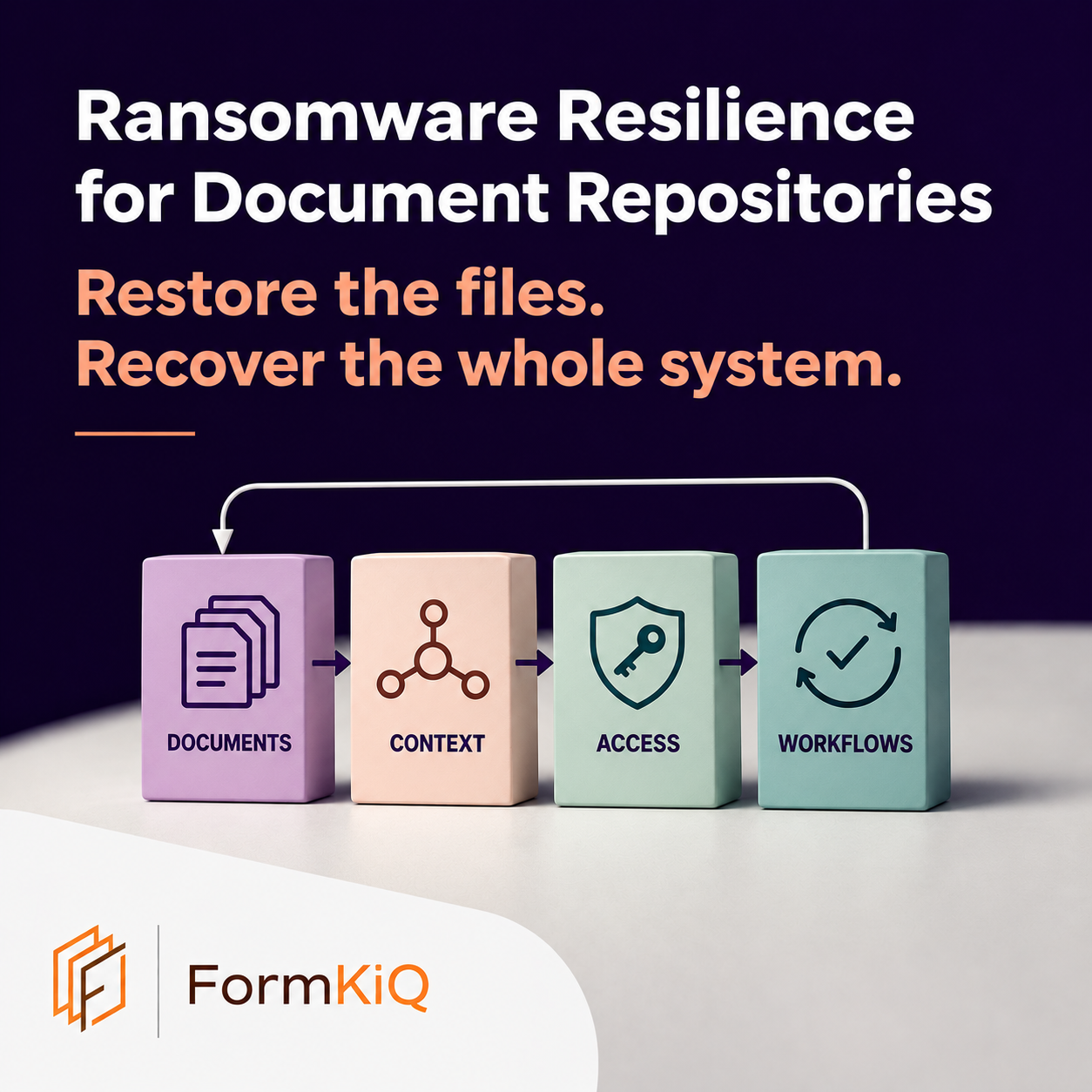
A document repository can have complete file backups and still fail a ransomware recovery. The files may return while their metadata, access rules, versions, relationships, search index, and workflow state remain missing or inconsistent.
That distinction matters now. The ENISA Threat Landscape 2026 identifies ransomware as the most impactful short-term incident type. Its reporting period covers January–December 2025, so it is context for the recovery threat model rather than a forecast of an individual organization’s exposure.
Recovery should be treated as a property of the whole document system, not a storage feature.
A document is more than its binary file
A useful document record usually includes several linked components:
- the original file and any generated renditions;
- custom attributes, classifications, and business identifiers;
- versions, revision status, and publication state;
- permissions and policy inputs;
- relationships to cases, contracts, employees, vendors, or transactions;
- retention rules, legal holds, and disposition state;
- workflow tasks, approvals, and exceptions;
- OCR text, extracted data, and search indexes;
- audit events showing who did what and when.
If recovery returns only the file, users may see a large collection of objects without the context needed to find, trust, govern, or process them. In a regulated workflow, that can be as disruptive as losing the files themselves.
Five recovery layers to test
1. Storage recovery
Confirm that source documents, generated outputs, thumbnails, and other required objects can be restored to a known point. S3 Versioning and AWS Backup can provide important controls, but they must be configured, monitored, and tested. Recovery procedures should account for malicious deletion, encryption, object replacement, and compromised administrative credentials.
2. Metadata and relationship recovery
Restore the metadata store to a point consistent with the document objects. Test whether document identifiers, paths, attributes, entity relationships, and retention state still resolve correctly. A file restored under a different identifier can break links from line-of-business systems even when the file itself is intact.
3. Identity and authorization recovery
A recovered repository should not default to broad access because an identity provider, group mapping, or policy service is unavailable. Test the dependency on SSO, role claims, Open Policy Agent policies, encryption keys, and administrative accounts. Define a controlled break-glass path, and record its use.
4. Processing and workflow recovery
Queues and workflow events can be duplicated, delayed, or lost during a disruption. Test whether processing is idempotent, whether failed work can be replayed safely, and whether approvals resume from an explainable state. A recovery that silently sends the same agreement for signature twice is not a successful recovery.
5. Search reconstruction
Search indexes are often derived data. It may be faster and safer to rebuild them from authoritative documents and metadata than to restore an index snapshot. Measure how long a complete reindex takes, what search functions are available during reconstruction, and how completeness will be verified.
Immutable is a policy outcome, not a checkbox
Immutability should prevent the same compromised identity from altering both production data and its recovery path. That usually requires separation of duties, restricted backup administration, independent retention controls, and monitoring for configuration changes.
Records retention and ransomware protection also have different goals. A retention policy may prevent premature deletion of a business record. A cyber-recovery policy protects a recoverable state of the system. They can reinforce each other, but one should not be assumed to satisfy the other.
For high-value records, consider how legal hold, WORM-style retention, backup vault controls, and account boundaries interact. Document who can extend retention, who can release a hold, who can restore data, and what approvals are required.
Define recovery in business terms
A recovery exercise should prove that people can complete their work safely. Test these six outcomes alongside infrastructure recovery.
- Claims
Retrieve the case evidence
Staff can find and open the evidence for an active claim.
- Procurement
Find upcoming expiries
The team can identify vendor certificates that expire this month.
- Legal
Identify the signed version
The executed agreement is distinguishable from its drafts.
- Records
Keep the hold effective
A legal hold remains enforceable after restoration.
- Audit
Reconstruct the incident
Actions before, during and after the incident remain traceable.
- Integrations
Reconnect the business record
Applications resume with document identifiers and links intact.
A successful backup job or matching object count is only a starting point. Business acceptance proves that the governed information is usable.
A practical test sequence
Work through four phases. Keep external side effects disabled until controlled replay and validation are complete.
Scope & prepare
- Select representative records with versions, metadata, permissions, holds and active workflows.
- Set recovery-point objectives (acceptable data loss) and recovery-time objectives (acceptable recovery duration) for each component.
Keep: Sample record manifest and agreed recovery objectives.
Isolate & restore
- Use incident evidence to choose a recovery point before compromise; verify backups and recovery tools are trustworthy.
- Restore into an isolated environment with production credentials and integrations disabled.
Keep: Recovery-point rationale, backup timestamps and isolation checks.
Validate & rebuild
- Check hashes, counts, relationships, permissions and lifecycle state.
- Rebuild derived OCR outputs or search indexes where appropriate; replay controlled events and confirm repeated delivery does not duplicate actions.
Keep: Validation results, rebuild timings and replay records.
Exercise & accept
- Have business users complete the six outcome checks above.
- Capture actual timings, manual steps, missing evidence and ownership gaps.
Keep: Business-owner sign-off and an assigned remediation list.
The output is a measured recovery capability with documented limits, owners and follow-up actions.
How architecture affects resilience
FormKiQ uses AWS managed services, including Amazon S3 and DynamoDB, in customer-managed or dedicated vendor-managed AWS deployments. In a customer-managed deployment, the organization has direct control over backup policies, encryption keys, monitoring, recovery regions, and account-level access. It also makes the dependencies visible: storage, metadata, events, identity, processing, and search can each be tested explicitly.
A dedicated account alone does not survive compromised account administrators, deleted keys or altered backups. Define a clean recovery identity, protected backup administration and recoverable encryption keys; test the chosen controls independently of production access. S3 Versioning alone is not an immutable backup.
The same flexibility creates responsibility. Customer-managed deployments need assigned owners for backup configuration, restore testing, key recovery, and incident procedures. Vendor-managed deployments should define the evidence, testing frequency, and recovery commitments the customer will receive.
The objective is simple to state and demanding to prove: after an attack, users must recover governed information, not merely a bucket of files.
Recovery acceptance: one claims file
Can the claims team safely resume this case?
Follow one approved document through its claim relationship, access rules, legal hold and pending workflow. This is a design exercise, not a reported incident or measured FormKiQ result.
Restore the file and context
Evidence to retainDocument and version IDs, object hashes, metadata cutoff and backup timestamps.
Pass whenThe approved version resolves to the expected claim, and cross-service cutoff differences are reconciled.
Restore access and hold
Evidence to retainIdentity/policy snapshot, key access, hold record and denied-access test.
Pass whenThe claims reviewer can retrieve the record, an unrelated user cannot, and the hold still blocks disposition.
Resume work safely
Evidence to retainWorkflow checkpoint, replay IDs, disabled external side effects and reconciliation results.
Pass whenNo duplicate correspondence or signature request is sent, and missing work is queued for controlled replay.
Approve recovery
Evidence to retainMeasured recovery point and recovery time, exceptions and business-owner sign-off.
Pass whenThe team can complete the claim task within its agreed recovery objective.
Acceptance rule: document the result at every gate. Record failed checks as exceptions with an owner and a remediation decision before approving recovery.
Plan recovery around governed records
Explore FormKiQ's Records Management solution, security and governance controls, and regional deployment options.
Contact FormKiQ to map recovery requirements across documents, metadata, search, and workflows.